
The best B2B price comes from negotiating the total deal—not just the unit cost. You need to look at MOQ, materials, payment terms, shipping costs, and quality standards together. When you negotiate all these parts as one package, you reduce your real cost per unit and protect your cash flow.
Most buyers I talk to make the same mistake. They think getting the lowest unit price means they won. But then they pay extra for tooling. Or they face high MOQ they cannot sell. Or shipping costs eat their savings. I have seen this happen too many times in the past 10 years at Cupique.
Negotiating the total deal, not just unit price, reduces real costs and protects cash flow.True
The text states negotiating all parts of the deal together reduces real cost and protects cash flow.
The best B2B vacuum flask price comes from negotiating only the lowest unit cost.False
The article explicitly advises negotiating the 'total deal' beyond just the unit cost for the best price.
Beyond the Unit Price: What Key Factors Should I Negotiate Besides the Obvious
Price per unit is just the start. You need to think about all the other factors that add to your total cost. If you ignore them, you will pay more than you think.
Beyond unit price, negotiate MOQ, tooling fees, customization costs, packaging options, quality standards, payment terms, and shipping responsibilities. Each of these factors changes your total landed cost. A low unit price means nothing if tooling adds $3,000 or if you must order 10,000 units when you can only sell 2,000.

Let me break this down for you. When you buy vacuum flasks from suppliers like us at Cupique, the unit price is the most visible number. But it does not tell the full story. You also need to look at these parts:
What Are the Hidden Costs You Should Ask About?
First, ask about tooling and mold fees. If you want custom logos, shapes, or lid designs, the supplier might charge you for new molds. This can cost from $500 to $5,000 depending on complexity.
Second, look at packaging costs. A basic color box might cost just a few cents. But a display box or gift packaging can add $0.50 to $1.00 per unit. I remember one client who wanted premium packaging. His cost jumped 15% because of the box alone.
Third, ask about quality certifications. If you need FDA, LFGB, or REACH compliance, some suppliers charge extra for testing and certificates. Others include it. You need to know upfront.
| Cost Factor | Typical Range | Negotiation Tip |
|---|---|---|
| Tooling/Mold Fee | $500 - $50,000 | Ask for waiver on repeat orders |
| Basic Color Box | $0.10 - $0.30 | Bundle with unit price |
| Premium Gift Box | $0.50 - $1.20 | Negotiate only if sales justify |
| Quality Certificates | $0 - $500 | Ask if included or extra |
| Sample Costs | $50 - $200 | Request refund on first order |
How Do Labor and Assembly Costs Affect Pricing?
Labor is a big part of your cost. If your vacuum flask has many parts—like a tea infuser, a handle, multiple seals—assembly takes time. More time means higher labor cost.
I worked with a buyer last year who wanted a complex lid with three parts. The assembly added $0.30 per unit just for labor. We talked about simplifying the design. He agreed to use a two-part lid. That saved him money and kept the quality high.
Also, think about the supplier's management structure. I once knew a competitor who had too many managers. His overhead was high. His prices were 10% above market. You pay for their inefficiency. Choose suppliers with lean operations.
Negotiating beyond unit price for factors like MOQ, tooling, and shipping is crucial for total cost.True
The text explicitly states many factors besides unit price change the total landed cost and should be negotiated.
A low unit price guarantees a low total cost, making other negotiation points less important.False
The article explains a low unit price means nothing if other factors like tooling or MOQ significantly increase total cost.
How Do Material, Customization, and Packaging Choices Impact My Final Quotation
Material choice is one of the biggest levers you can pull. Different stainless steel grades, finishes, and combinations change your cost a lot. You can save money if you understand your real needs.
Material grade, surface finish, and inner-outer steel combinations directly impact your quotation. Using 304 stainless steel for the inner wall and 201 for the outer shell can reduce cost by 15-20% compared to full 304 construction. Surface treatments like powder coating cost about $0.10-$0.15 more than spray painting. Choose based on your market's expectations, not just the highest grade.
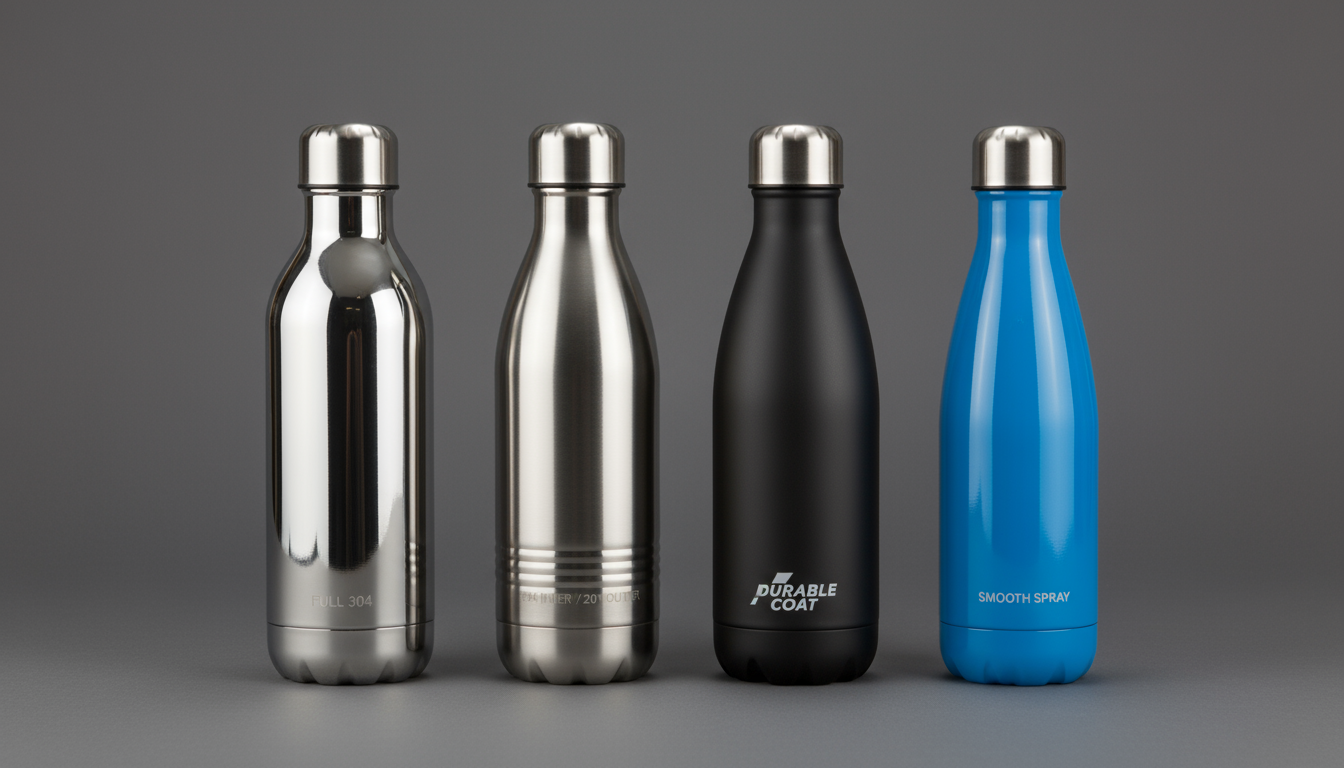
Let me explain how materials work in vacuum flask production. At Cupique, we use food-grade stainless steel for safety. But there are smart ways to balance cost and quality.
What Is the Cost Difference Between Steel Grades?
The most common grades are 304 and 316 stainless steel. Both are food-safe. But 316 costs about 20-30% more because it has better corrosion resistance1. For most markets, 304 is enough.
Here is a cost-saving trick I share with my B2B clients. You can use 304 steel for the inner wall (which touches liquid) and 201 steel for the outer shell (which does not). This combination keeps your product safe but cuts material cost by 15-20%2. Your customers cannot tell the difference from the outside.
But be careful. Do not use 201 steel for the inner wall3. It is not food-grade. I knew someone who tried to save money this way last year. His entire shipment failed inspection. The buyer sent everything back. He lost over $20,000 because he cut corners on the wrong thing.
How Do Surface Treatments and Finishes Affect Price?
Surface finish changes both look and cost. The main options are spray painting and powder coating.
Spray painting is cheaper. It gives a smooth finish. But it can chip more easily. Powder coating costs about $0.10 to $0.15 more per unit. But it is more durable. It resists scratches better.
| Material/Finish Choice | Cost Impact | Best For |
|---|---|---|
| Full 304 Steel | Baseline | Premium markets |
| 304 Inner + 201 Outer | -15% to -20% | Budget-conscious buyers |
| Full 316 Steel | +20% to +30% | High-end, marine use |
| Spray Paint Finish | Baseline | Basic retail |
| Powder Coating | +$0.10 - $0.15 | Outdoor, sports bottles |
What About Customization and Branding Costs?
Logo printing method also matters. Silk screen printing is the cheapest. Laser engraving looks premium but costs more. Full-color heat transfer is in the middle.
If you order many units, the per-unit branding cost drops. But for small orders, it can add $0.50 to $1.00 per flask. I always tell clients to start with simple one-color logos. Test the market first. Then upgrade if sales justify it.
Packaging is similar. A basic white box is cheap. A full-color display box looks better but costs more. I had a client who insisted on premium packaging for his first order. He spent $2,000 extra on boxes. Half his inventory did not sell. He wished he had started simple.
The lesson is clear. Match your material and customization choices to your market. Do not overspend on features your customers do not value. And always negotiate these as part of your total deal.
Mixed stainless steel grades can significantly reduce manufacturing costs.True
Using 304/201 steel combination can reduce cost by 15-20% compared to full 304.
Powder coating is a cheaper surface treatment option than spray painting.False
The text states powder coating costs $0.10-$0.15 more than spray painting.
What Is the Relationship Between Order Quantity (MOQ) and Price, and How Can I Negotiate It
Order quantity is the strongest price lever you have. The more you buy, the less you pay per unit. But MOQ can also trap you if you cannot sell the volume.
MOQ and unit price have an inverse relationship. Larger orders reduce per-unit costs by 20-40% because suppliers save on raw material procurement, setup time, and production runs. However, negotiate MOQ flexibility for trial orders. Start with a higher unit price on 500-1,000 units to test your market, then commit to 5,000+ units at lower prices once you prove demand.
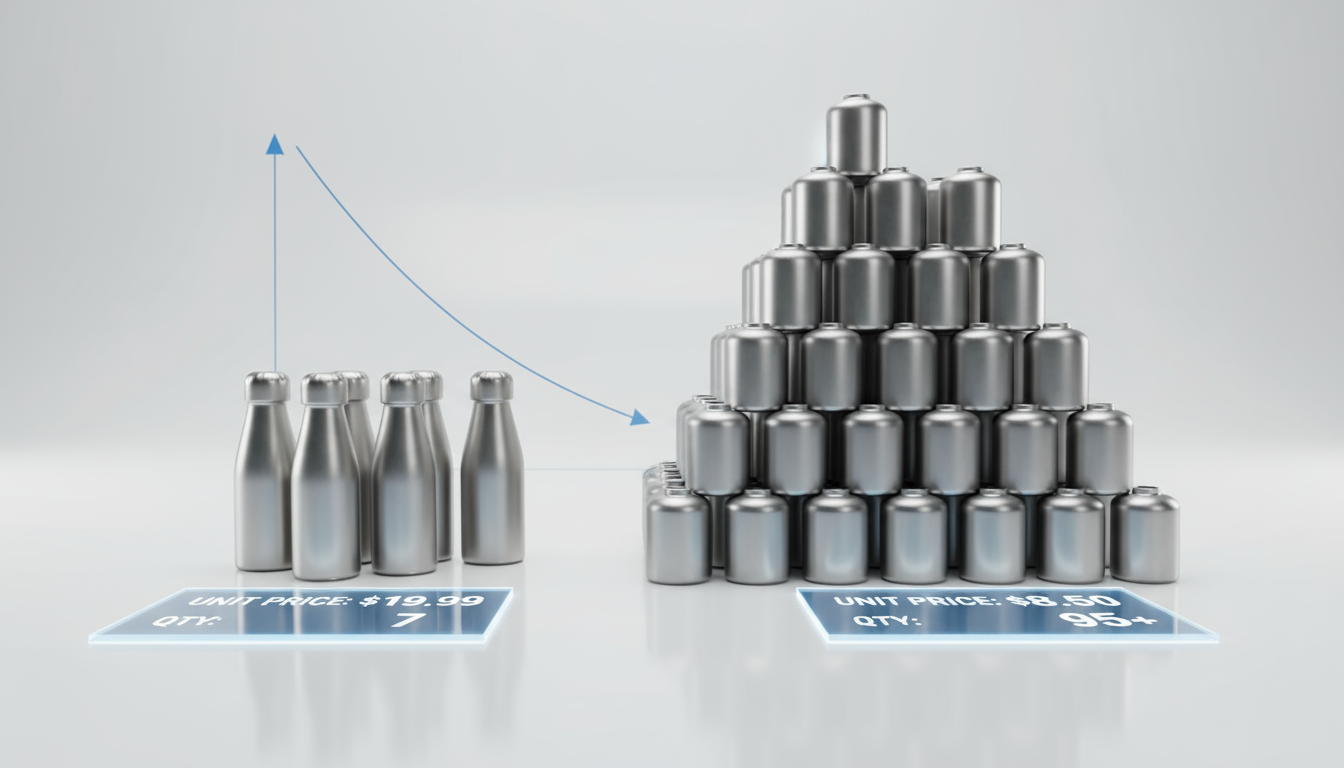
Let me show you how this works in real production. At Cupique, our costs drop significantly as order size grows. Here is why.
Why Does Higher Volume Lower Your Unit Cost?
First, raw material purchasing power increases. When I buy stainless steel for a 1,000-unit order, I pay market price. But for a 10,000-unit order, I can negotiate with my steel supplier. I get bulk discounts. Those savings pass to you.
Second, production setup time gets spread across more units. We need about 2 hours to set up our production line for any order4. For 500 units, that is 14 seconds per unit. For 5,000 units, it drops to 1.4 seconds per unit. You pay less for that overhead.
Third, packaging and labor efficiency improves. Our workers get into rhythm. They pack faster. Mistakes drop. We can offer better prices.
How Should You Structure Your MOQ Negotiation?
Here is what I recommend. If you are new to vacuum flasks, do not start with a huge order. Negotiate a trial MOQ even if the unit price is higher.
For example, ask for 500 units at $4.50 each instead of 5,000 units at $3.20 each. Yes, you pay more per unit. But you risk only $2,250 instead of $16,000. Test your market first.
Then, negotiate a tiered pricing structure upfront. Get it in writing:
| Order Quantity | Unit Price | Total Cost | Savings vs 500 Units |
|---|---|---|---|
| 500 units | $4.50 | $2,250 | Baseline |
| 1,000 units | $4.00 | $4,000 | -11% per unit |
| 3,000 units | $3.50 | $10,500 | -22% per unit |
| 5,000 units | $3.20 | $16,000 | -29% per unit |
| 10,000 units | $2.80 | $28,000 | -38% per unit |
This way, you know exactly what price you get when you scale up. No surprises. You can plan your inventory and cash flow.
I also suggest negotiating volume commitments. Tell the supplier you plan to order 10,000 units over the next year. But you want to release them in batches of 2,000. Many suppliers will give you the 10,000-unit price if they see the commitment.
What If the MOQ Is Still Too High?
If the supplier's MOQ is 3,000 units but you can only handle 1,000, try these tactics:
First, ask if you can split the order into different designs or colors. Maybe 500 units in blue, 500 in black. This hits their 1,000 MOQ but gives you variety.
Second, find a partner to share the order. If you know another buyer who needs similar flasks, combine your orders. Split the shipment later.
Third, negotiate a higher deposit. Some suppliers reduce MOQ if you pay 50% upfront instead of 30%5. Your money reduces their risk.
Remember, suppliers want long-term partners. If you show serious commitment and growth potential, they will work with you on MOQ. I do this for my clients all the time.
Larger order quantities (MOQ) generally result in lower per-unit prices from suppliers.True
Suppliers offer discounts on larger MOQs due to savings in raw materials and production efficiency.
Suppliers are unwilling to offer MOQ flexibility for initial trial orders.False
The text advises negotiating MOQ flexibility for trial orders to test market demand before committing.
How Do Incoterms and Payment Terms Affect My Total Cost and Cash Flow
Shipping terms and payment structure are often ignored. But they can change your total cost by 10-30%. They also determine when you pay and when you get your goods.
Incoterms define who pays for shipping, insurance, and customs. FOB means you handle everything from the port. EXW is cheapest quoted price but you arrange all logistics. DDP means the supplier delivers to your door but costs most. Payment terms like 30% deposit or Net 30 affect your cash flow. Negotiate longer payment terms or smaller deposits to keep cash in your business longer. Also negotiate who bears currency and raw material fluctuation risks.

Many buyers focus only on the unit price. Then they get shocked by shipping and duties. Let me help you understand these terms.
What Do Different Incoterms Mean for Your Cost?
Incoterms are standard trade terms. They define responsibilities between buyer and seller. The most common ones for vacuum flasks are:
EXW (Ex Works): The supplier just hands you the goods at their factory. You arrange and pay for everything—domestic transport, export clearance, ocean freight, import clearance, duties, delivery. The quoted price is lowest but you do all the work.
FOB (Free on Board): The supplier delivers goods to the port and loads them on the ship. You pay for ocean freight, insurance, import clearance, and duties. This is the most common term for B2B deals.
CIF (Cost, Insurance, Freight): The supplier pays for ocean freight and insurance to your destination port. You pay for import clearance and duties. Simple but you have less control over shipping.
DDP (Delivered Duty Paid): The supplier handles everything and delivers to your warehouse. Easiest for you but most expensive.
| Incoterm | Supplier Pays | Buyer Pays | Best For |
|---|---|---|---|
| EXW | Factory loading only | Everything else | Experienced importers |
| FOB | To ship at origin port | Ocean freight, duties, delivery | Most B2B buyers |
| CIF | Ocean freight, insurance | Duties, local delivery | Simple imports |
| DDP | Everything | Nothing (included in price) | First-time importers |
How Should You Choose the Right Incoterm?
I usually recommend FOB for experienced buyers. You get control over your freight forwarder. You can compare ocean freight rates. You can time your shipments better.
But if you are new to importing, DDP is safer. Yes, you pay more. But you avoid mistakes with customs. You know your total landed cost upfront. No surprises.
Let me tell you a story. Three years ago, a client from Australia ordered from us EXW. He wanted the lowest price. But he had never imported before. His freight forwarder messed up the customs documents. His goods sat at the port for two weeks. He paid storage fees and penalties. In the end, he spent more than if he had chosen DDP.
What Payment Terms Should You Negotiate?
Payment terms affect your cash flow more than you think. Standard terms are 30% deposit and 70% balance before shipment6. But you can negotiate better.
Try these tactics:
Ask for 10% deposit instead of 30%. This keeps more cash in your business. Offer to pay the balance faster in exchange. For example, 10% deposit and 90% within 7 days of production completion.
Request Net 30 or Net 60 terms. This means you pay 30 or 60 days after receiving goods. Most Chinese suppliers say no at first. But if you show good credit history or offer a letter of credit, some agree.
Negotiate early payment discounts. Offer to pay 100% upfront in exchange for 3-5% price reduction. If you have strong cash flow, this saves money.
Lock in currency rates. If you pay in USD but the supplier buys materials in RMB, exchange rates can shift. Negotiate a fixed exchange rate for the contract period.
I remember one buyer who negotiated 50% deposit and 50% payment 30 days after delivery. He used that 30 days to sell half his inventory. His cash flow stayed healthy. He could grow faster.
How Do You Protect Against Cost Fluctuations?
Raw material prices change. Currency rates move. You need protection.
Negotiate a clause that fixes your price for a set period. For example, your quote is valid for 90 days. After that, both sides renegotiate if steel prices change by more than 10%.
Also, ask about currency risk sharing. If you pay in USD but RMB strengthens by 5%, you could share that cost increase. Both sides take less risk.
The key is to discuss these points early. Do not wait until you sign the contract. Put everything in writing. Clear terms prevent problems later.
Incoterms define who pays for shipping, insurance, and customs responsibilities.True
The text explicitly states Incoterms define who pays for these aspects of shipping.
DDP (Delivered Duty Paid) Incoterms are generally the cheapest option for buyers.False
The text states DDP "costs most" as the supplier handles all logistics to the buyer's door.
Conclusion
Negotiating B2B vacuum flask prices is about the total package, not just unit cost. Focus on MOQ flexibility, material choices, payment terms, and shipping responsibilities. Prepare with market data, build supplier relationships, and always know your walk-away point to secure the best deal.
-
Explains properties and manufacturing costs of 316 stainless steel. ↩
-
Guide on manufacturing stainless steel bottles, detailing material choices for safety and cost. ↩
-
Explains material choices and food-grade standards for stainless steel bottle manufacturing. ↩
-
Illustrates manufacturing benchmarks and efficiency gains with production scale. ↩
-
Explains common MOQ negotiation tactics, including payment terms. ↩
-
Explains common payment terms, including deposits and balances before shipment. ↩